

By Anne Manning | The SOURCE
In order to understand how light and matter interact at atomic and subatomic scales, scientists must strip their measurements of these interactions down to the bare essentials.
In the laboratory of Dylan Yost, associate professor in Colorado State University’s Department of Physics, the study palette of choice is hydrogen, which is made of up just one electron and one proton. Because of this element’s very simple structure, Yost and his team can take measurements of forces inside these individual atoms, as they try to unify those measurements with longstanding theories about how the universe works.

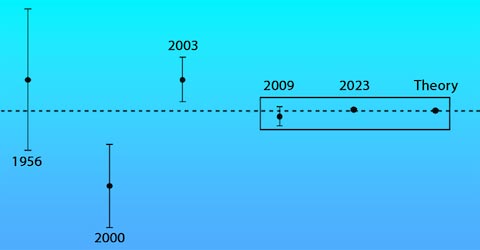
The lab recently achieved one such extremely precise measurement – using lasers, supercooled hydrogen, and radio frequency electromagnetic waves – that characterizes the magnetic interaction between the proton and electron in a hydrogen atom. This quantum interaction manifests in the splitting of the atom’s electron energy levels, which physicists refer to as the “2S1/2 hyperfine interval.” Measuring this interval is a coveted achievement for physics because it allows for the testing of quantum theories using real numbers.
The CSU physicists detail their achievement in the journal Physical Review Letters. Using a custom-built spectroscopy tool that involves cooling hydrogen atoms down to a few degrees Kelvin, the researchers were able to capture the magnetic interaction inside a single hydrogen atom within 1 part in 100 million. “This is the same precision you would have if you measured the distance from California to New York to an accuracy of about 1 centimeter,” Yost said.
Their measurement supports the theory of quantum electrodynamics, which is a 100-year-old set of predictions within the Standard Model of Physics. Quantum electrodynamics is the mathematical description of all possible interactions between electrically charged particles via the movement and exchange of photons, which are elementary particles of light.

The CSU group’s measurement was in line with what the theory predicts, which means “the theorists working in quantum electrodynamics did a very good job,” Yost said.
The group who worked on the project and authored the paper included CSU undergraduate students Michael Weiss and Scott Johnson, both of whom are excited by the prospect of helping constrain confidence intervals around forces that are so fundamental to, well, everything.
“Eliminating possible precision errors in every step of our measurement was really cool to be a part of, and to see how it was all done,” Weiss said.

Johnson was especially awed by the ability to work closely not only with the lab’s advanced instrumentation, but also to pick up where others in the lab had left off in order to achieve their results.
“What we’re doing is continuing to build that knowledge higher and higher,” Johnson said.