

By Anthony Lane | Colorado State University
(Photographs courtesy of CSU Libraries, Archives & Special Collections)
On Colorado’s 150th anniversary, we revisit a CSU wheat variety that defied the odds and helped establish the state’s agricultural industry
What are the connections between Colorado State University and the state of Colorado? The Centennial State turns 150 years old in 2026, while CSU marks its 156th anniversary this year – a perfect time to explore how the university has contributed to the state. Watch for monthly features on the topic.
These days, wheat developed at Colorado State University is the undeniable star of the school’s innovation ecosystem. Over six decades, CSU’s Wheat Breeding and Genetics Program has released dozens of wheat varieties bred to succeed in Colorado, a state known for wild variations in landscapes and weather. These varieties have thrived so well that they account for 85% of the wheat grown in Colorado – making the crop one of the most important in Colorado and a stalwart in the state’s robust agricultural industry.
In fact, unique varieties of wheat generate more annual revenue for CSU than any other intellectual property at the university – about $1.81 million of a total $3.33 million each year. That’s a remarkable 54% of the total, with most of the revenue going right back into research.
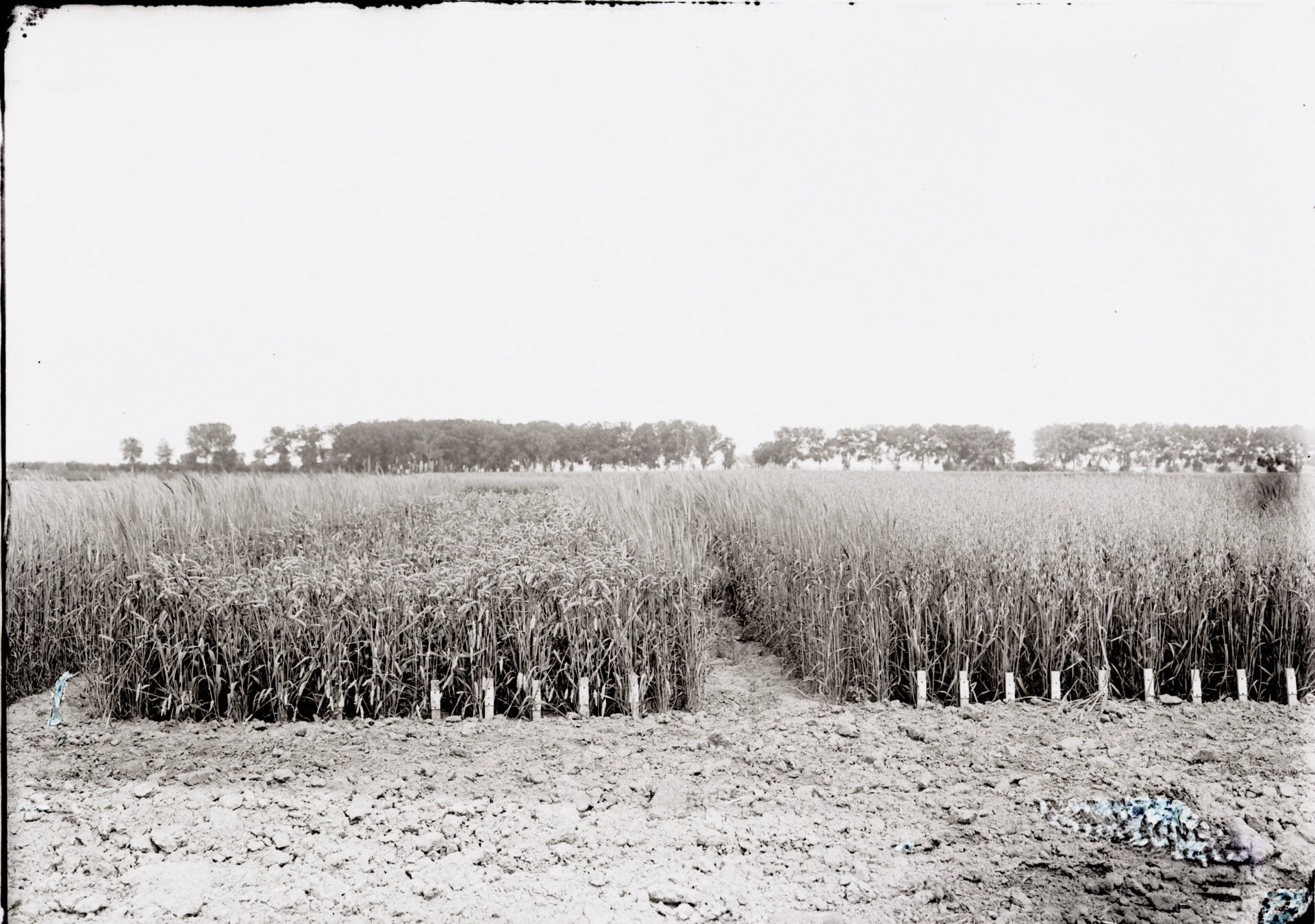
Turns out this research has an origin story in the form of Defiance wheat, a variety cultivated here in the late 1800s by Ainsworth Blount. He was the very first professor of agriculture at Colorado Agricultural College, which became CSU. As you might guess, Defiance wheat defied Colorado’s harsh growing conditions and flourished so well that it nabbed newspaper headlines.

Defiance wheat also exemplifies the ways Colorado Agricultural College influenced and shaped Colorado during its earliest years: The crop helped establish the state’s critical agricultural industry when many doubted a semi-arid climate would allow it. At the same time, Defiance wheat demonstrated the power of college research to define and solve real-world problems, a mission CSU continues today.

“Defiance wheat highlights the university’s origins in experimentation and problem solving to improve lives and strengthen the state’s economy,” said Eugene Kelly, a CSU professor of soil science who leads the Colorado Agricultural Experiment Station. “The creativity and energy of the college’s first researchers paved the way for agriculture to become a $47 billion industry in Colorado.”
Defiance wheat was among the first crops bred and tested at Colorado Agricultural College. It was also the first – and perhaps only – crop to become a celebrity.
Rocky Mountain News stories told of the grain winning bread-making contests and thriving at 10,000 feet. In 1911, a news story reported on a Montrose man who produced 71 bushels of Defiance wheat per acre, the best wheat production anywhere in the country that year.
Fame was fleeting for Defiance wheat, yet the crop provided lasting proof that a scientific approach to agriculture could yield dividends.
Blount was the researcher behind the crop. He was a Dartmouth-educated pioneer in the science of crossing and breeding wheat and corn. Hired in 1879, he was one of three faculty members who welcomed the college’s first class of five students.
Outside the classroom, Blount ran the college’s Experimental Department, testing potatoes, corn, beans and other crops to see what would grow well in Colorado. By 1886, he had experimented with 343 varieties of wheat, according to Democracy’s College in the Centennial State, the CSU history written by the late James Hansen.

Defiance wheat was the standout. After receiving a small sample of Defiance seed from Vermont in 1879, Blount planted the wheat on a test plot, selected the best, and then “crossed the best on the best” for progressive improvements. At the beginning, the plant had a head less than 3 inches long with about 20 kernels. Blount reported that the irrigated spring wheat eventually had a head of 5 to 6 inches long, holding an average of 43 kernels.

A tribute to Blount, published in American Breeders Magazine the year after his death in 1911, called Defiance wheat “his gift to the Irrigated West, demonstrated by miller and farmer to be the best milling spring wheat grown on the irrigated lands of America.” A 1922 article in the Rocky Mountain News estimated that the crop’s high yield increased Colorado’s wealth by almost $14 million over the preceding two decades.
Recognizing the varied growing conditions between Colorado’s plains and its mountain valleys, Blount was also an early champion for the idea of branching beyond Fort Collins to establish agricultural research centers in distinctive areas.
A month after the U.S. Congress passed the Hatch Act of 1887, providing $15,000 in annual funding to the country’s land-grant colleges to support agricultural experimentation, that vision started to become a reality when state lawmakers directed the creation of four additional experiment stations across the state.
Today, CSU’s Agricultural Experiment Station has 11 research sites, including sites on the Front Range, Western Slope, San Luis Valley, and Eastern Plains.

Defiance wheat’s future would not be as expansive. Like many wheat varieties of that era, Defiance was a tall plant, prone to falling over, or lodging, when fully grown, which increased the time and expense of harvest. It also required irrigation. The variety all but disappeared following the Green Revolution of the 1950s and ’60s, when crop scientist Norman Borlaug and other innovators released waves of disease-resistant wheat varieties with short stems and high yields.
CSU launched its Wheat Breeding and Genetics Program in 1963 to ensure that Colorado farmers would benefit from that revolution. Esten Mason, head of the program, said CSU has released more than 75 wheat varieties since then. Today, he explained, most wheat in Colorado is produced without irrigation, and there are varieties that can produce 30 bushels per acre with just 4 inches of precipitation.
Mason spoke appreciatively of Blount’s work and the success he achieved in slightly more than a decade. “The goal was to find what was best adapted to Colorado,” Mason said. “That never changes.”
Blount served briefly as the college’s acting president in 1882 and left CSU in 1890, taking a similar plant-breeding position at what is now New Mexico State University. When Blount left, Defiance wheat’s heyday was still ahead.
“Defiance wheat highlights the university’s origins in experimentation and problem solving to improve lives and strengthen the state’s economy.”- Eugene Kelly, deputy director, Colorado Agricultural Experiment Station
The crop covered 194,000 acres across the country in 1919, according to a U.S. Department of Agriculture report. Then, over the decades, it almost disappeared. But Mad Agriculture, a Boulder organization that supports regenerative agriculture, included Defiance wheat in its 2021 catalog, reporting that it had found a pound of seeds for “Colorado’s most famous wheat” in Vermont.
For the right grower – one focused on producing what would now be a specialty, artisanal crop – that means there’s still a chance of starting a new chapter for Defiance wheat.