


Nancy Jones, NCBA Secretary
Mid-April to late June is a typical time for honey bee swarm season in Colorado. “We will be expecting swarms to emerge in the next couple of weeks” according to Beth Conrey, Past-President of the Colorado State Beekeepers Association (CSBA).
The Colorado State Beekeepers Association (CSBA), a statewide organization of beekeepers, is dedicated to honey bee health. For the past 9 years, they are running the “Swarm Hotline” and are asking people to keep an eye out for swarming honey bees. As part of the CSBA, the Northern Colorado Beekeeper’s Association has established a swarm Hotline for this region: 970-658-4949. The toll-free statewide number for swarm calls is: 844-779-2337 (844-SPY-BEES).
What is a swarm?

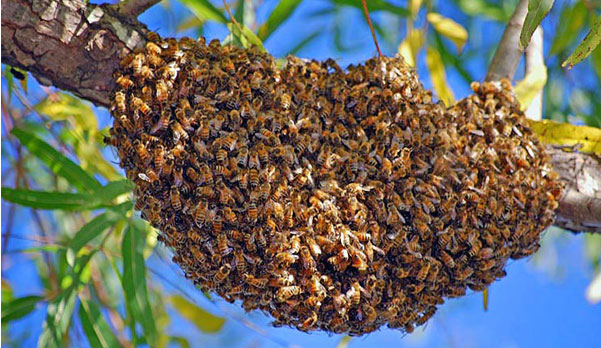
A swarm is one of the true wonders of nature. Swarms emerge in the spring when a healthy hive becomes too crowded and part of them leave to form a new hive. When the queen lands on a branch or post, the rest of the bees all land near her forming a “ball of bees”. Swarms are harmless—but can be intimidating to the average citizen. Conrey says, “Do not spray a swarm with water or insecticide. Simply pick up the phone and call the swarm hotline. We will dispatch a beekeeper to pick it up—usually within an hour.” Swarms are not only a fascinating natural process of honey bee reproduction; they are a sign of something promising: healthy honey bees in Colorado.
Bee colony health: The problem
The health and well being of honey bees has been in jeopardy since 2006. Beekeepers began reporting losses of 30-90 percent of their hives, according to the U.S. Department of Agriculture (USDA). Bee scientists say there’s no single explanation for Colony Collapse Disorder (CCD), it’s just everything that bees are exposed to these days: pests, pathogens, pesticides, and the lack of floral diversity.
Guide for Action:
CSBA wants to make people more aware of the important link between healthy honey bee populations, human interaction, and our food supply. According to the National Resources Defense Council (NRDC), bees pollinate more than $15 billion worth of crops each year in the United States alone. Put another way, one of every three bites of food Americans consume comes from a plant visited by bees or other pollinators. Without bees, many fruits, vegetables and nuts (especially almonds) would disappear from our diets.

How is Colorado affected by swarming?
There are thousands of managed bee colonies in Colorado and are typical of colonies throughout the country with losses in the 30-70% range annually. Bees that are healthy enough to swarm are called “survivor” bees and are crucial to sustaining bee populations in Colorado.
What to do if you see a swarm?
If you see a honey bee swarm in the northern CO region, please call the SWARM HOTLINE:
970-658-4949. for other areas: 1-844-779-2337 (844-SPY-BEES) or for more information about honey bees and swarms go to www.coloradobeekeepers.org and www.nocobees.org
Nancy Jones
NCBA Secretary