

Andrew Scott, Horticulturist | The Gardens on Spring Creek

When conceptualizing a garden, one of the all-too-common oversights people make is underutilizing grasses. Turf grass has its place, but it is admittedly rather boring and utilitarian. Luckily, there’s a huge palette of hardy ornamental grasses adapted to our climate that can be added to a landscape to add texture and movement, improve a garden’s year-round interest, soften hard edges like walls or pathways, and reduce your water bill.

As you begin including grasses in your landscape, keep in mind their three basic attributes: season, inflorescence type, and height. Cool-season grasses, like fescues and feather reed grasses, do the bulk of their growth in the milder spring and fall, flowering and setting seed around May and June, and are dormant through the heat of summer. Conversely, warm-season grasses like bluestems, gramas, and switchgrasses push growth in the heat of summer and tend to flower around August and September. It comes as a surprise to many people that grasses do, in fact, have flowers, but what most folks call “seedheads” are actually made up of flowers to comprise the “inflorescence”. Make sure to include a mix of warm and cool season grasses of differing heights and inflorescence types to create a balanced and interesting landscape all season long.
Little bluestem (Schizacyrium scoparium) is one of my favorite landscape grasses. Native across most of the US, this warm-season bunchgrass gets two to three feet tall and two feet wide, although some cultivars can be up to 4½ feet tall, making it versatile in a border or as a specimen plant in prairie or meadow gardens. True to its name, the leaves have a blueish-green to powder blue color that turn a striking purple, red, or orange in the fall, topped with narrow spikes of fluffy and tawny seeds. Look for cultivars such as ‘Blue Heaven’, ‘Prairie Blues’, ‘Blaze’, ‘Twilight Zone’, and ‘Standing Ovation’, a Plant Select selection introduced in 2016.
Big bluestem (Andropogon geradrii) is, predictably, little bluestem’s taller cousin. Another warm-season native, big bluestem gets up to eight feet tall and three feet wide, so it’s great as a standalone specimen plant or in a mass planting to create screening. Its inflorescence is quite unique, with 3-6 long upright spikes at the end of the stem, making an iconic “turkey’s foot”. Common cultivars include ‘Red October’, which turns from a purple-tinged green to a vivid burgundy in autumn, and ‘Blackhawks’, with its deep blue-violet foliage that fades to a pinkish purple in autumn. Plant Select also has a selection called WINDWALKER® big bluestem that turns a lovely plum in September!
Blue fescue (Festuca glauca) is a cool-season bunchgrass native to the Mediterranean that does fabulously in our climate. Cultivars like ‘Elijah Blue’ and ‘Boulder Blue’ make for pleasant powder blue mounds that only get about a foot tall, so they work great in border plantings, rock gardens, and cottage gardens. They are short-lived perennials, however, living 2-4 years before their centers start dying out, but propagate well by seed or division. Idaho fescue (F. Idahoensis) is a native fescue that gets slightly larger than blue fescue with much showier seedheads and a longer lifespan. ‘Siskiyou Blue’ is a spectacular cultivar with ivory herringbone inflorescences that erupt from wiry blue foliage in late spring to catch the rising and setting sun.

A mainstay of residential landscaping since 2011, ‘Blonde Ambition’ blue grama is another Plant Select bunchgrass — I promise they’re not paying me to promote their plants — that reaches around three feet tall, double the height of the native straight species Bouteloua gracilis. An excellent warm-season grass for mass plantings in meadow or prairie gardens, or even as a standalone rock garden plant, Blonde Ambition shines in midsummer and into fall. It has a distinctive, purple-tinted chartreuse eyelash-shaped inflorescence that curls up in late summer and is retained through winter; these seedheads catch morning and evening light and make for excellent accents in flower arrangements, too!
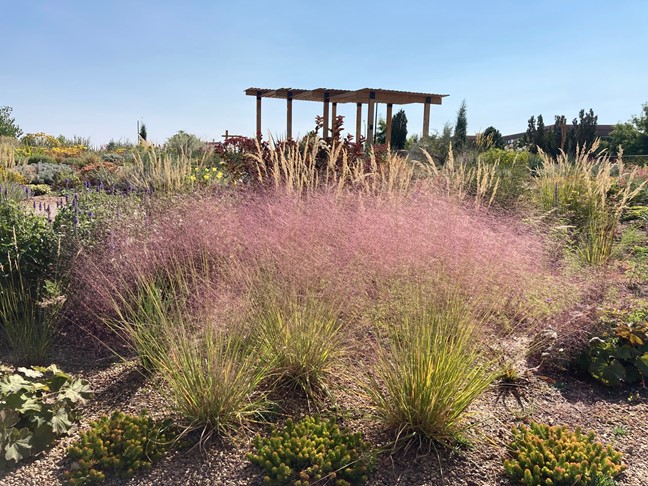
UNDAUNTED® ruby muhly is another amazing choice to place in a spot where it will be backlit. Selected by the Gardens’ own Lauren Springer, Muhlenbergia reverchonii ‘PUND01S’ is a small, warm-season grass that creates a two-foot mound. The foliage isn’t much to write home about and looks like any other unassuming bunchgrass for most of the season, but come September, it explodes into dense sprays of pastel pink panicles that look fantastic in mass plantings or along pathways where they can dance in the breeze and graze your legs as you walk by.
Shrubs and perennials tend to receive the limelight in a garden, but grasses can do it all, providing a structure cornerstone to a bed, softening borders, accenting other plants, and adding interest in every season. Next time you’re at a nursery, give their grass section and look-see before making that B-line to the perennials.