

By Andrew Scott | Gardens on Spring Creek

In Lewis Carroll’s 1871 novel Through the Looking-Glass, the Red Queen tells Alice that in Looking-Glass Land, “it takes all the running you can do, to keep in the same place.” This nonsensical statement gave rise to a concept in evolutionary biology known as the Red Queen hypothesis: species must keep running just to stay in the same place, that is, they must adapt and evolve to simply live and reproduce.

(via sciencephoto.com)
An evolutionary arms race takes place between the hunter and the hunted, each looking to survive, hoping to be stronger, faster, smarter, more ferocious than the other. This concept also applies to plants, not just the animals and microorganisms that want to eat them. From a human perspective, it may seem impossible for a bush to be strong, fast, smart, and ferocious when it’s rooted in place. Still, plants are in this ever-evolving arms race too, and employ several adaptations to deter getting chomped on, primarily via physical barriers and chemical weapons.

Physical Defenses
Many plants have evolved to possess a dizzying array of specialized structures that create physical barriers to hinder herbivores.
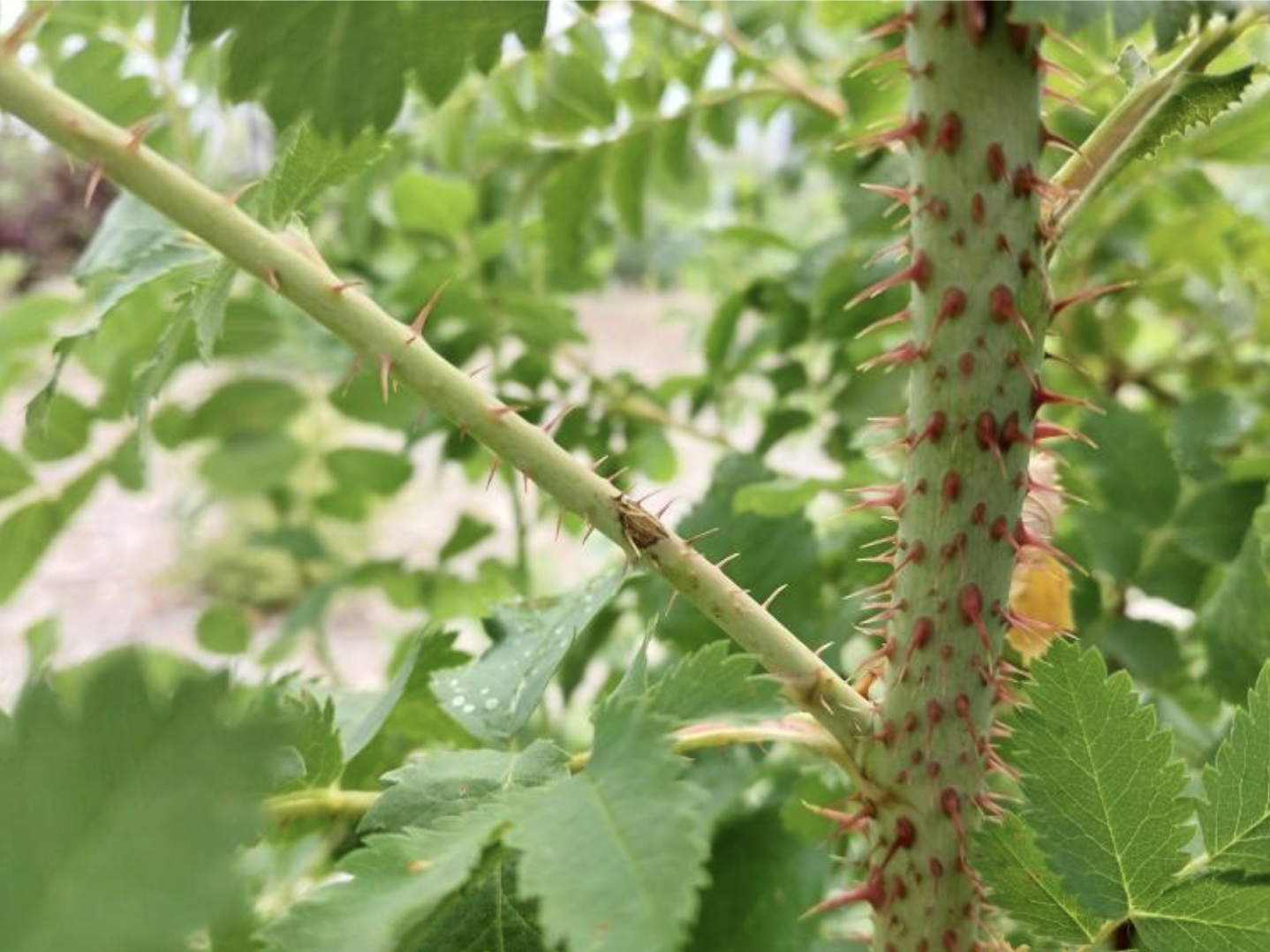
Pokey things that physically puncture the tissues of herbivores are some of the most common defenses used by plants. Skin is the first line of defense against pathogens, so when this layer is damaged, herbivores quickly learn not to touch the pokey things, especially if they keep getting pricked long after they’ve left the plant alone. Thorns, prickles, and spines are all pokey extensions, but are differentiated by the part of the plant that has been modified. Thorns are actually live wood born from modified stem tissue, as can be seen on trees like acacia, Russian olive, and honey locust. Prickles, meanwhile — such as those equipped by roses, thistles, and raspberries — are stiff, non-living extensions of the outer layer of stem tissue (or epidermis).

Prickles on Woods’ rose (Rosa woodsii) at the Gardens on Spring Creek.
Conversely, spines, such as those found on cacti, holly, and Oregon grape, are modified leaf tissues that have forgone their role in photosynthesis in favor of thickening and hardening to defend the plant. Some New World cacti take spines even further by developing glochids, which are hooked spines that dig into the skin to cause even greater irritation, similar to fiberglass.

Thinking on a much smaller scale, plants also employ structures called trichomes, from the Greek trikhoma, meaning “hair”. On the scale of an aphid, these tiny hairs might as well be a jungle of undergrowth that physically keeps the insect from proceeding to the actual surface of the plant, where they can cause damage.

Dense trichomes on this woolly plantain (Plantago patagonica) in Nunn, Colorado, keep insects off the plant’s leaf surfaces.
Some plants don’t even need to employ barriers to dissuade herbivores since they have mastered the art of not being seen. Some plants camouflage themselves by mimicking their surroundings, while some take it further and look like entirely different materials. For example, a genus of succulents native to southern Africa called Lithops has evolved to resemble a mere pebble on the ground, hardly anything worth stopping to look at, much less eat. Similarly, plants endemic to coasts and dunes may exude sticky glandular secretions that catch blowing sand, allowing them to blend into the scenery or dissuade herbivores with a mouthful of grit.

Spotted spurge (Euphorbia maculata) camouflaged among a gravel pathway.
Speaking of grit, grasses have developed a few tricks of their own to dissuade herbivory. They are among the main types of plants that incorporate indigestible silica into their tissues, thereby reducing palatability and increasing wear on both teeth and mandibles. As with thorns, prickles, and spines, many grass species also have seeds equipped with variably long, sharp, and bristly awns that can become painfully embedded in the nose, lips, cheeks, tongue, or throat of an herbivore, encouraging them to move onto something less irritating. It’s like having a tickling hair stuck in your throat all day.
Sometimes plants take mechanical defenses into their own hands, erm… leaves. Some plants, like sensitive plants (genus Mimosa) will curl up their leaves when touched or vibrated, a response called thigmonasty. On top of being quite a neat phenomenon to witness, it’s been hypothesized that thigmonasty lessens the surface area of the leaves and lowers the chance of herbivory by larger animals, or it can be swift enough to fling off tiny insects that might seek to chomp into it.
Observing organisms interact is one of the most fascinating parts of nature—and nothing illustrates this better than seeing how a targeted species defends itself to survive another day. Whether it’s by formulating noxious chemical compounds, putting up a pokey barricade, calling for backup, or avoiding detection altogether, plants have evolved delightfully sophisticated defense systems that keep them one step ahead of their environment’s predators. And, their predators respond in kind to this evolutionary arms race—running, running, running to keep in the same place.
This article comes to you in two parts. If you would like to learn about how plants use chemical weapons to defend themselves, visit The Gardens on Spring Creek’s blog: https://gardensonspringcreek.blogspot.com/2025/07/when-plants-fight-back-part-2.html