

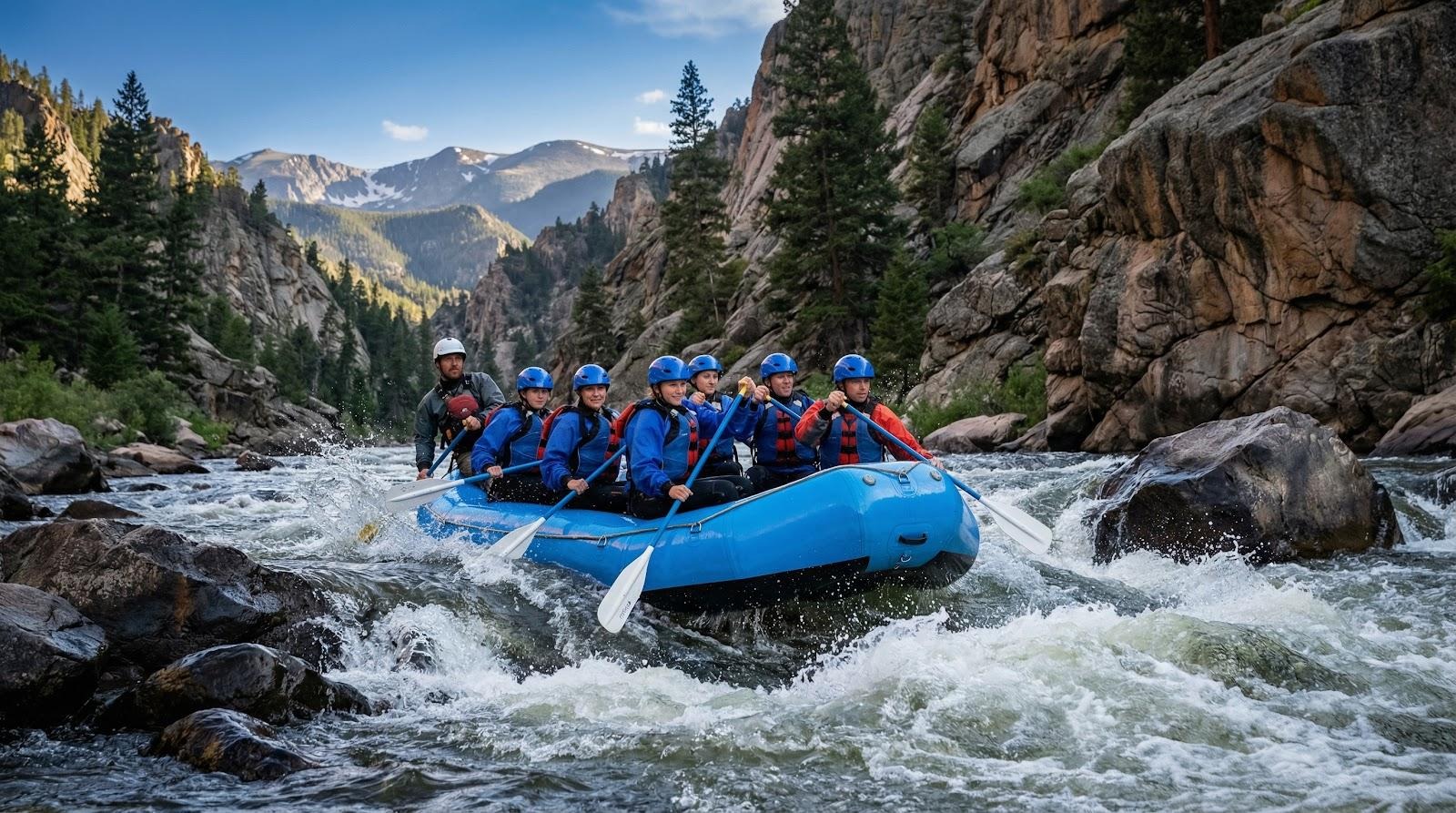
Snowmelt still roars, icy spray still slaps your face, and a raft still drops into walls of white—yet 2026 looks different. According to CBS Colorado, statewide snowpack sits at just 61 percent of normal—a fifth percentile low—so the high-water window may slam shut early.
Use this guide to squeeze every rapid in while it lasts. We rank Colorado’s five most electrifying Class IV and V runs, explain our scoring system, and spotlight fresh river changes (see Echo Canyon Expeditions’ 2025 season review for context).
Ready to pick your line? Let’s dive in.
How we selected the top five
Choosing stand-outs in a state packed with Class IV and V white water demanded more than instinct, so we built a five-factor scoring model you can audit line by line.
Thrill factor carries 30 percent; big drops and stacked hydraulics deserve top billing.
Scenery and uniqueness account for 15 percent. A thousand-foot canyon ceiling or a sky-high bridge turns a rapid into a memory.
Flow reliability weighs in at 20 percent. We reviewed reservoir-release calendars, historic CFS charts, and 2026 runoff projections to learn how often each reach actually runs.
Accessibility holds 15 percent. Remote wilderness earns stories, yet drive time from Denver, shuttle complexity, and train access still matter when vacation days are limited.
Guide depth and safety record round out the final 20 percent. More seasoned Class V guides and multiple outfitters translate into stronger safety culture and easier booking.
Add the weights, and you get a transparent ranking that balances heart-pounding excitement with real-world bookability.

Royal Gorge, Arkansas River: the granite corridor that tests your grin
Slide under a bridge that hangs 955 feet above the river and the world tightens to frothing water, polished granite, and your own pulse. Royal Gorge delivers 10 miles of stacked Class IV white water that pushes into Class V when early June runoff peaks.

Sunshine Falls blasts the raft into a diagonal wave, Sledgehammer hits from the right, and Boat Eater waits around the bend to flip anyone day-dreaming. Even at average flows you link rapids so quickly that flat water feels mythical.

Reliability locks in the Gorge’s top spot. Upstream reservoirs release steady water that keeps levels raft-able through mid-August, so you are not wagering vacation days on a lucky melt. Add the 1-hour drive from Colorado Springs and you get extreme white water that still fits a summer road-trip clock.
Guides rave about the scenery as much as the hydraulics. Granite walls climb 1,000 feet, hawks spiral overhead, and for a heartbeat you spot tourists peering down from the suspension span before the next lateral wave fills your view.
The river even rewrote itself last season.
Echo Canyon River Expeditions’ 2025 Colorado Rafting Review documents Royal Gorge flows between 1,200 and 2,500 CFS during the VFMP-managed peak window and notes that a spring storm toppled the first new boulder in roughly twenty years, enough to reshape the line yet still run clean at both high and low water.
Guides now mention the unnamed rapid in every safety talk, a reminder that this canyon is always shifting.
Half-day trips cover roughly 3 hours dock to dock, cost about $120 and welcome paddlers 14 and older at normal flows. When water surges past 2,000 CFS, outfitters raise the age limit or pause trips until levels settle. Bring grit, a snug helmet and the will to paddle on command, and the Gorge will repay you with a grin that lasts beyond the take-out.
Gore Canyon, Colorado River: Colorado’s ultimate Class V gauntlet
Gore Canyon feels like the river version of a black-diamond chute: once you drop in, turning back is not an option.
The put-in sits below Green Mountain Reservoir, and the water tumbles almost immediately through Applesauce, a 10-foot opener that signals the day’s intent. From there the canyon stacks legends you will replay at camp: Gore Rapid with its Ginger hole, Scissors, Toilet Bowl and the plunge at Tunnel Falls.
Prime season arrives in late summer. Carefully timed dam releases hold flows in the 800 – 1,200 CFS sweet spot, giving thrill-seekers a second window after other rivers taper off. That reliability, paired with raw intensity, earns the run our number-two slot.
Logistics thin the crowds. You meet guides before dawn, rumble 45 minutes down a dirt road, then spend 6 hours paddling, scouting and catching breath in eddies barely big enough for a raft. Outfitters cap trips at 6 – 8 guests and often assign a safety kayaker for rapid response.
Expect firm prerequisites. Companies require documented Class IV experience, strong swimming skills and an honest fitness check. In return you gain Colorado’s fiercest commercial white water and a wilderness so quiet you hear your heartbeat between rapids.
Pine Creek and the Numbers, Arkansas River: nonstop white-water sprint
If Royal Gorge feels like a roller-coaster, Pine Creek and the Numbers feel like someone folded the track.
You launch above Pine Creek Rapid, a steep chute that drops about 200 feet per mile. Guides snap commands as the raft threads Entrance Exam, bends around S-Turn and free-falls through Triple Drop. In a single minute you lose more vertical than some rivers give up all day.
There is no break. The river funnels straight into the Numbers, seven Class IV rapids packed so tight you count them by paddle hits. Number 4 narrows to a door-frame squeeze, Number 5 hammers with a wave train and the next hit arrives before adrenaline from the last one fades.

The payoff is intensity within reach of paved roads. Buena Vista’s ramps sit 1 hour from Breckenridge and 2 ½ hours from Denver. Flow-management releases hold solid water into mid-August, though early June still brings the monster levels many rafters crave.
Trips run as half-days: 6 miles and roughly 2 hours on water. Outfitters charge about $160 and set the minimum age at 15, raising it if water spikes. Show up limber and ready to paddle nonstop; blink and you miss a rapid, hesitate and you meet Granite bedrock up close.
Upper Animas, San Juan Mountains: wilderness marathon in a raft
Most rivers give you highlight reels. The Upper Animas hands you the entire movie.
Starting near Silverton at 9,000 feet, the river sprints 24 miles to Rockwood, dropping through Tenmile Canyon, No Name Falls and Broken Bridge with no road in sight. Continuous Class IV water, punctuated by honest Class V moves, demands focus hour after hour.
Access feels cinematic. You board the historic Durango & Silverton Narrow Gauge train at dawn, step off beside glacial water and zip a drysuit before the whistle fades. Once afloat, snow-rimmed peaks frame every horizon while the river chatters under your hull like wagon wheels on cobblestone.

Guides treat this trip like an expedition. Two-day outings split the mileage with a riverside camp; one-day epics pack it into 8 relentless hours. Either way you paddle hard, eat big and sleep well.
The season is brief. High snowmelt in June pushes flows near 2,000 CFS, then water drops so quickly that by early July rafts scrape rock. Catch it right and you notch one of North America’s longest stretches of commercial Class IV-plus white water. Miss the window and you wait a year.
Fitness rules are firm. Outfitters run swim tests, cap groups at 6 and charge about $880 for the privilege. The price buys solitude, bragging rights and the rare thrill of conquering a river that refuses to be tamed.
Clear Creek lower canyon: big hits, short commute
Imagine finishing breakfast in Denver, lacing a wetsuit 40 minutes later and, by mid-morning, threading a raft through Double Knife’s pinched rock gates.
Clear Creek’s Lower Canyon runs just 5 miles yet packs more gradient per mile than any other commercial stretch in Colorado. Outer Limits starts the sprint, Hells Corner kicks the boat sideways and the Phoenix holes at the finale test teamwork one more time.
High water comes fast. Late-May snowmelt can triple flows overnight, turning a playful creek into a narrow Class IV-plus challenge. Guides watch gauges and launch when levels sit in the 300 – 600 CFS window. By the second week of July the show fades and outfitters move on.
Accessibility seals the deal. Put-ins sit 1 mile off Interstate 70, so shuttles take minutes, not hours. Trips cost about $110 and wrap by lunch, leaving time for Idaho Springs hot springs or a brewery burger.
Expect small crews, often 4 paddlers plus a guide, because tight boulder gardens demand quick pivots. You will paddle constantly, catch spray in the face every few strokes and finish with forearms humming. For weekend warriors or visitors on a tight schedule, Clear Creek proves a one-hour drive can still deliver Class IV bragging rights.
Colorado’s extreme trips at a glance
You have the details, but seeing the numbers side by side helps you lock in the best match for your budget, calendar and appetite for adrenaline.

Map of Colorado showing locations of top five Class IV-V rafting trips
| Trip | Core difficulty | Best months | On-water time | Price (approx.) | Min. age | Stand-out features |
| Royal Gorge, Arkansas | Class IV that spikes to V in high water | May – mid Aug | 3 h (half-day) | $120 | 14 | 1,000-ft granite walls, new 2025 rapid |
| Gore Canyon, Colorado | Steady Class V | Aug – early Sep | 6 – 7 h (full-day) | $180 | 18 | Ginger hole, Tunnel Falls, wilderness solitude |
| Pine Creek + the Numbers, Arkansas | Class V opener, sustained IV | Early Jun – late Jul | 2 h (half-day) | $160 | 15 | 7 rapids in 2 mi, 200 ft/mi gradient |
| Upper Animas, San Juan | Long Class IV+ with V cruxes | Late May – Jun | 2-day (or 8 h sprint) | $880 | 16 | Train access, 24-mi wilderness marathon |
| Clear Creek lower canyon | Class IV+ in peak runoff | Late May – early Jul | 1 h (half-day) | $110 | 15 | 40 min from Denver, rapid-fire drops |
Safety and preparation: your pre-launch checklist
Great white water delivers smiles only when everyone returns to the van healthy. A few deliberate steps before launch keep risk low and the thrill high.
First, follow the dress code. Cold snowmelt drains strength fast, so pull on the outfitter’s wetsuit or splash jacket even if the sun feels warm at the ramp. Wear secure footwear that will not drift away. Pack a dry change of clothes in your car for the ride home.
Gear up with the non-negotiables: a Coast Guard-approved life vest, snug helmet and a paddle you can grip with wet hands. One veteran rescue leader repeats each spring, “Life vests, life vests, life vests, and a helmet.”
Fitness matters more than bravado. A short routine—planks, push-ups and two swim sessions a week—builds the core and shoulder endurance you will need after the third surf hit.
Listen during the safety talk. Guides explain how to sit, how to swim if you fall in and when to paddle like your day depends on it. Memorize the commands before the first rapid; there is no time to refresh in the middle of Sunshine Falls.
Finally, share any medical needs up front. An inhaler or epi-pen does no good if the crew does not know you carry one. Transparency helps guides plan for contingencies and lets everyone chase rapids with a clear head.
Conclusion
Colorado’s Class IV and V rivers pack a season’s worth of adrenaline into just a few prime weeks. Pick the run that matches your skill, budget and travel window, train for the demands, and grab your seat while the snowmelt still surges. When flows subside, you will have stories—and maybe a few bruises—that last far beyond summer.