

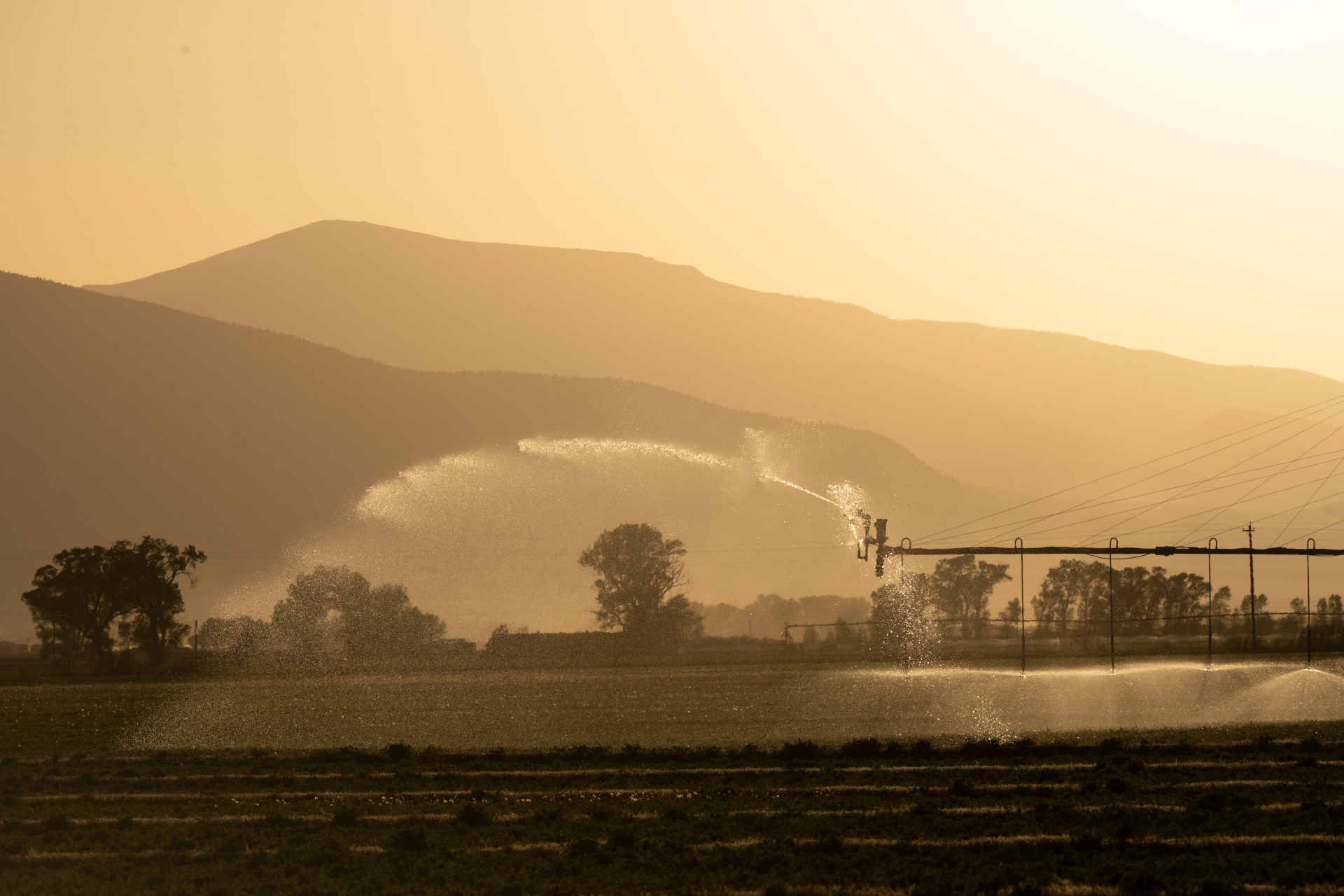
Research finds avoided land conversion far outweighs irrigation emissions
By North Forty News Staff | NorthFortyNews.com
FORT COLLINS, Colo. — Agricultural irrigation in the United States produces greenhouse gas emissions, but its ability to increase crop yields and prevent additional land from being converted to agriculture creates a much larger climate benefit, according to new research from Colorado State University.
The study found that if U.S. irrigation were eliminated, additional agricultural land would be needed to compensate for lost crop production. Researchers estimated the greenhouse gas emissions associated with that land-use change would be 363 times greater than current annual emissions from U.S. irrigation.
The research was published Sept. 14 in the Proceedings of the National Academy of Sciences.
Agricultural irrigation allows farmers to produce more food on less land. That matters for greenhouse gas emissions because converting forests, grasslands and other natural ecosystems into agricultural land releases carbon stored in vegetation and soils.
Researchers estimated that irrigation currently avoids approximately 6.86 gigatons of greenhouse gas emissions associated with land-use change.

“It was clear from this work that irrigation has a net positive effect on emissions,” said lead author Avery Driscoll, who conducted the research as a CSU doctoral student and is now a postdoctoral researcher at Purdue University. “The avoided emissions from reductions in indirect land-use change were much greater than the direct emissions, and that could decline further with electrification.”
Irrigation Still Carries an Emissions Cost
Irrigation itself is not emissions-free.
Pumping water on farms and moving water between basins requires energy and accounts for the largest share of irrigation-related emissions identified by the researchers. Other direct emissions include nitrous oxide released through microbial activity and dissolved carbon dioxide released when groundwater is sprayed onto fields.
Researchers said electrifying pumps currently powered by fossil fuels could reduce those direct emissions further.
The new study builds on previous CSU research into irrigation emissions by comparing those direct costs with the indirect greenhouse gas benefits created by avoiding additional agricultural land conversion.
Researchers mapped irrigation’s effects on crop yields at the county level across the United States. They then used a global economic model to estimate changes in production, consumption, trade and land use if U.S. agriculture relied entirely on rainfall.
Those estimates were combined with information about carbon stored in soils and vegetation to calculate emissions associated with the additional land conversion.

A Western Water Trade-Off
The findings have particular relevance in the western United States, where irrigation is essential to much agricultural production but water supplies face competing demands.
Nathan Mueller, a CSU associate professor in the departments of Ecosystem Science and Sustainability and Soil and Crop Sciences, said greenhouse gas emissions represent only one consideration in larger decisions about water.
“We’re able to show this large benefit of U.S. irrigation to greenhouse gas emissions from the food system,” Mueller said. “Yet, when we talk about water use, particularly in the western U.S., there are trade-offs with every use and trade-offs beyond food and beyond greenhouse gas emissions.”
The research also has a direct connection to Colorado agriculture.
CSU alumnus Alex Brown’s family has farmed and ranched in Yuma County for 120 years. Brown said irrigation allows farmers to maintain production without turning less productive and more environmentally sensitive pasture into cropland.
“We need irrigation to fulfill our needs and our duty to continue to feed the world,” Brown said.
His family continues to invest in technology and equipment designed to improve irrigation efficiency.
Driscoll said irrigation can simultaneously increase agricultural productivity and resilience to heat and drought, making it important to understand both its environmental costs and benefits.
“Irrigation is a powerful adaptation strategy,” Driscoll said. “It increases productivity; it increases resilience to heat and drought stress, and of course, maintaining and increasing agricultural production is a critical priority.”
The researchers noted that their analysis did not examine every source of agricultural emissions, including emissions associated with nitrogen fertilizer use or methane from livestock.
The study was funded by the National Science Foundation and the AI Institute for Land, Economy, Agriculture & Forestry, supported by the U.S. Department of Agriculture.
Source: Colorado State University. Read the original CSU report and research published in the Proceedings of the National Academy of Sciences.
Local news, community stories, events and updates delivered directly to your inbox.
START YOUR FREE 30 DAYS