


By Laurel Aiello | Fort Collins Nursery
Tropical orchids are known for their elegant, colorful, and often fragrant blooms, making them a popular choice for housewarming gifts and wedding bouquets. In fact, many believe these tropical flowers symbolize love, beauty, and strength. But they are also a complex houseplant that comes in many different species, requiring some knowledge of how to care for them in an unnatural environment—aka a dry Colorado home.
Know your orchid type
The most common orchid species are epiphytes, meaning they grow on trees in the wild instead of on the ground and require a specific potting medium. However, some terrestrial orchids, like Venus Slipper (Paphiopedilum) and Jewel orchids (Ludisia discolor), grow in soil and can be potted like a regular houseplant. Out of the tens of thousands of orchid species, many of them fall into these four types:
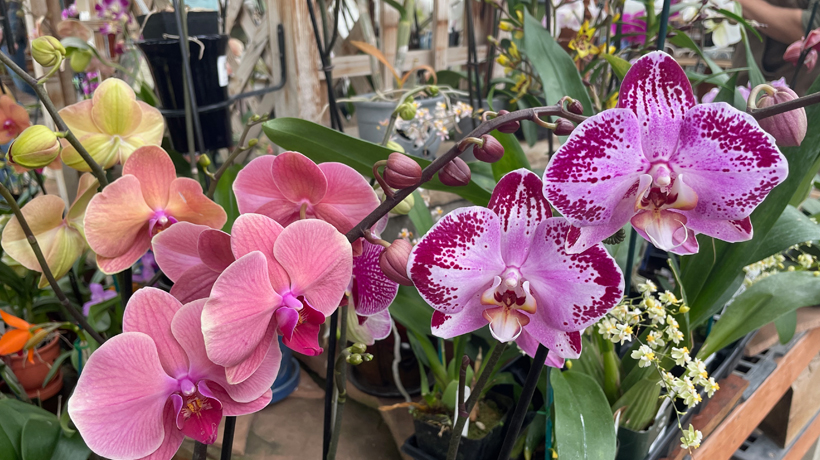
Phalaenopsis (epiphyte, easy care), also known as “moth” orchids, are the ones typically found in grocery stores and are easily recognized by their broad leaves and large, rounded flowers along thin stalks. More forgiving than other orchid types, their relatively simple care and long-lasting blooms make them a great option for beginners.
Dendrobiums (epiphytes, medium difficulty) are often chosen for their fragrant blooms and long, thick stems with clusters of small flowers. Fan favorites include Dendrobium kingianum and Dendrobium speciosum, known for their honey-like scent; Dendrobium nobile, with a slightly sweet fragrance; and Dendrobium wardianum, loved for its caramel-like scent.
Cattleya (epiphyte, medium difficulty) flowers emerge atop bulb-like stems and come in a range of pinks, whites, and purples. Dubbed the “queen of orchids,” the skinny Cattleya maxima, ruffly Cattleya trianae, and broad Cattleya walkeriana are popular choices.

Oncidiums (epiphytes, medium difficulty), also known as”dancing lady” orchids, form clusters of small, often fragrant blooms with colorful patterns in red, brown, yellow, and pink. The Sharry Baby variety is especially popular, with its heavenly chocolate-vanilla scent.

Basics of care
Orchids thrive in warm, humid areas with medium to bright indirect light (depending on the species), and wide varieties bloom more frequently when temperatures drop at night. If potted in an orchid medium, soak epiphyte varieties’ roots in lukewarm water for 15 minutes about once per week. If mounted on a tree or another structure, thoroughly mist the roots with distilled water every day or two. IMPORTANT: Never place ice cubes on an orchid’s roots, as this shocks the plant and damages the root system. Ice cubes also don’t provide enough water.
When repotting an orchid, it’s best to wait until it is no longer in bloom, as the stress of repotting can cause flowers to drop. To start, remove the plant from its container and discard the old potting medium. Trim any sections of roots that are flat and brittle or brown and slimy (healthy roots are firm and white or green). Soak the healthy roots in lukewarm water for about a half-hour, then pack fresh potting medium into the central cavity of the root system before lowering it into the new pot. Gently fill the gaps with additional potting medium, avoiding snapping the roots. Apply an orchid-specific fertilizer in spring or summer, when the plant is producing new growth.
Orchid Soil Recipes
Courtesy of Fort Collins Nursery

These ingredients can be found at Fort Collins Nursery, located at 2121 E. Mulberry St. in Fort Collins. Pre-mixed orchid medium is also available.
General Orchid Mix:
6 parts orchid bark
1 part large horticultural charcoal
1 part sponge rock
Phalaenopsis Orchid Mix:
1 part orchid bark
1 part sphagnum moss