

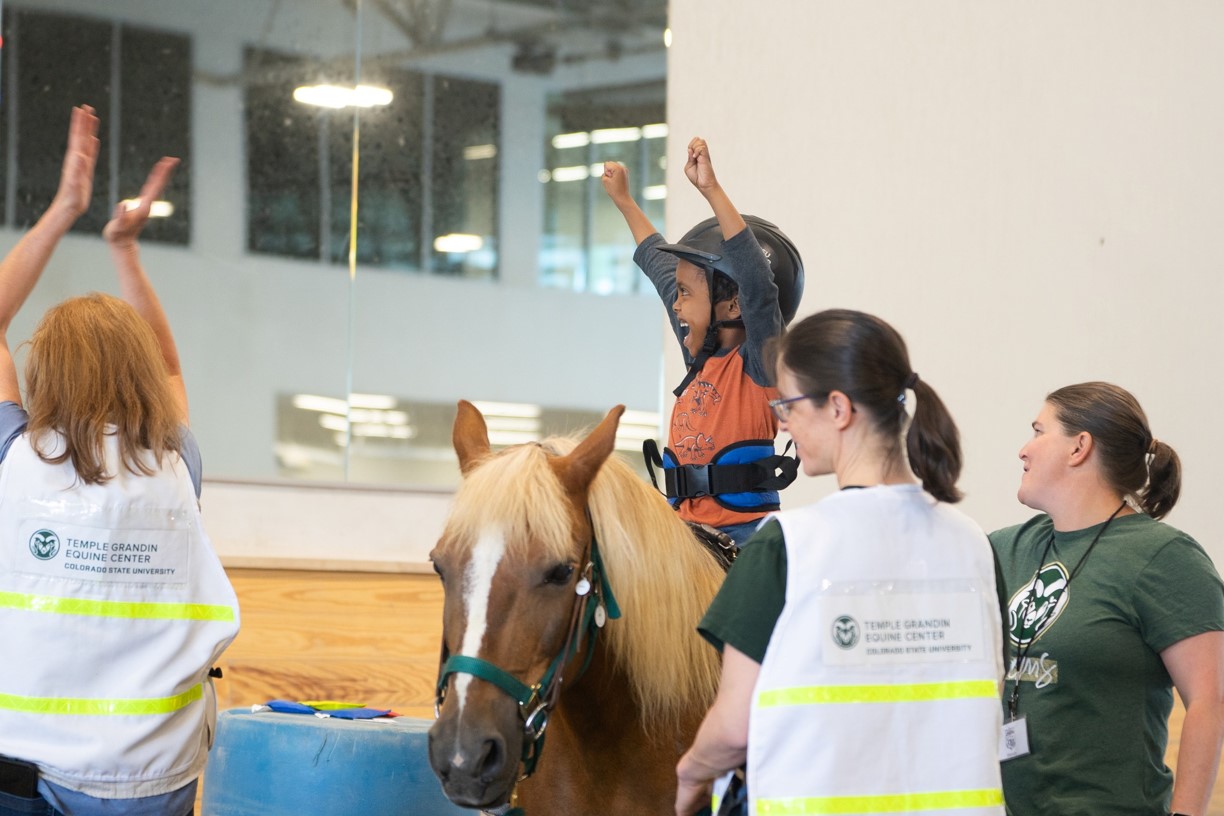
Colorado State University researchers found that occupational therapy involving horses reduced a stress-related hormone more than traditional clinic-based treatment.
By North Forty News Staff | NorthFortyNews.com
A new Colorado State University study provides scientific evidence for what therapists and families have observed for years: Horses can help children with autism feel calmer and more engaged during therapy.
Researchers at CSU’s Temple Grandin Equine Center found that children in horse-based occupational therapy showed greater reductions in cortisol, a stress-related hormone, than children receiving similar therapy in traditional clinical settings.
The findings, published in the Journal of Autism and Developmental Disorders, offer new insight into how interactions with horses may benefit autistic children.


Measuring the Benefits of Horse Therapy
The study followed 72 children ages 6 to 11 who participated in weekly occupational therapy sessions over 10 weeks. Researchers divided participants into two groups, comparing horse-assisted therapy with treatment in a conventional clinic.
Researchers collected saliva samples throughout each session and measured cortisol and alpha-amylase, two biological markers associated with the body’s stress response and nervous system activity.
While cortisol levels decreased in both groups, children working with horses experienced significantly greater reductions.
Researchers also observed changes in alpha-amylase levels, suggesting children became more physiologically activated during therapy before returning to baseline afterward. Combined with lower cortisol, the findings may indicate positive engagement rather than distress.
“That power of the horse-human interaction for autistic children has often been referred to as ‘magic,’ but this study provides empirical data to support and explain how interacting with horses impacts autistic children physiologically,” said Caiti Peters, a CSU assistant professor and research leader at the Temple Grandin Equine Center.

A Connection That Encourages Engagement
Peters said some autistic children arrive at therapy experiencing heightened physiological arousal, which can make participation difficult. Working with horses may help them calm down while staying motivated to engage.

The research builds on a 2021 CSU study that found children participating in horse-assisted occupational therapy made progress toward personal goals, demonstrated increased social motivation, and experienced decreased irritability.
The latest findings add physiological evidence to those earlier behavioral observations, although they do not establish that horse-assisted therapy produces better long-term outcomes for every child.

A Northern Colorado Connection
The research is part of ongoing work at the Temple Grandin Equine Center, which operates facilities in Fort Collins and Denver and hosts approximately 11,000 appointments annually.
The center is named for Temple Grandin, the internationally recognized CSU professor whose own experiences with horses helped shape her career in animal science and advocacy for people with autism.
Grandin has frequently described how working with horses as a teenager helped her navigate personal challenges.

Today, researchers at the center are exploring the science behind those connections, including how therapy affects both children and the horses involved.
“There is an animal-human bond,” said center director Adam Daurio. “So, as we explore, ‘What is that animal-human bond? Why do we enjoy it? Why is it self-motivating?’ Those are the questions we really want to answer with our research.”
For Northern Colorado families, the findings provide additional evidence that incorporating horses into occupational therapy may offer meaningful benefits for some autistic children.
Attribution: This article was prepared by North Forty News using information provided by Colorado State University’s College of Agricultural Sciences and SOURCE. Original reporting by Allison Sylte, CSU. Research findings were published in the Journal of Autism and Developmental Disorders. (Photos by Kevin Samuelson / Colorado State University Photography)