

Northern Colorado is a living classroom. Canyon rivers, foothill trails, and alpine basins turn standards into evidence students can touch. This guide helps you choose the best outdoor education field trip for Colorado schools—whether an instructor-led investigation, a teacher-run exploration, or a blended day that offers both. Inside, you’ll find a quick destination scorecard, a planning timeline, and budget-smart program ideas so you can align curriculum, access needs, and cost before you reserve the bus.
Decide Your Delivery Model
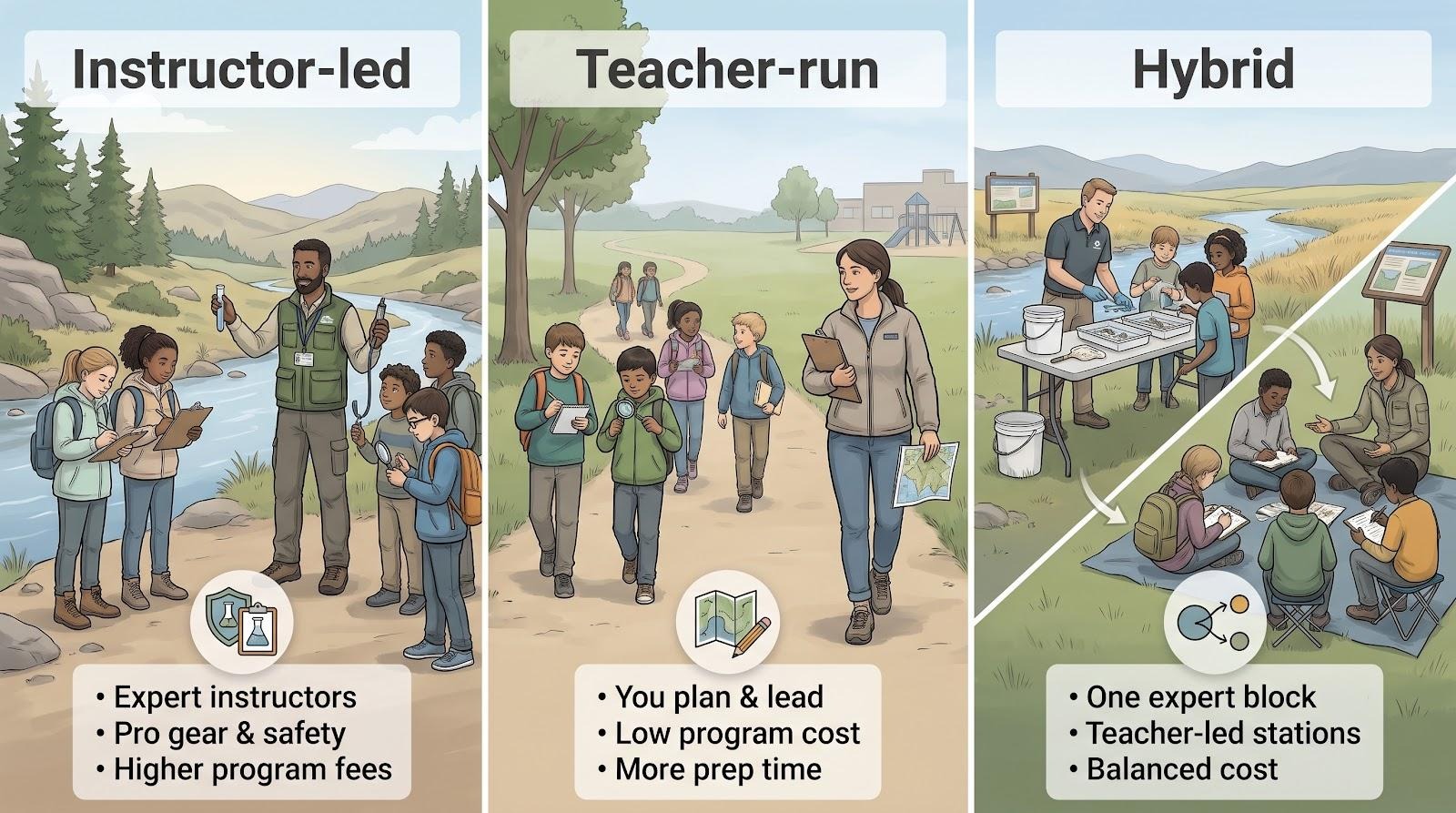
Your first planning decision is who leads the lesson and who pays for it. Colorado schools usually pick one of three options:
Instructor-led field trips
Need a real-world example of a fully instructor-led model?
Pali Institute, an accredited outdoor education provider in Southern California, runs single-day trips at two campuses, Pali Mountain and Pali Acton. Younger explorers in grades 3–5 start with group games and team building, then hike to learn forest ecology and wilderness skills; older groups in grades 4–12 can choose an arts day, a leadership day built around a high ropes course, or an outdoor experience where teachers select three classes to customize the trip.
Program staff lead the activities while visiting teachers focus on supervision and reflection. You gain specialist instruction, gear, and safety routines, but you cover program fees and work within the provider’s calendar, so popular dates fill early.
Teacher-run (self-guided) field trips
You design the investigation, set the pace, and avoid program fees. In return, plan for extra time to scout the site, gather materials, and write the emergency plan. This route works best on familiar local trails where flexibility matters more than specialized equipment.
Hybrid field trips
A site educator delivers one high-impact block, such as a water-quality lab, then students rotate through teacher-led journals, art, or mapping stations. Costs fall between the two options, and larger groups can cycle without overcrowding. The hybrid model brings expert depth without giving up schedule control.
Choose the option that fits your objective, budget, and timeline before you book the bus.
What the Research Says About Outdoor Learning

Academic Engagement and Conceptual Learning
A study by the American Institutes for Research of California outdoor science programs found a 27 percent gain in students’ measured mastery of science concepts (American Institutes for Research, 2005). Novelty alone does not produce that kind of gain, so field tasks need a clear question and follow-up analysis back at school.
Social-Emotional Lift and Class Community
A mixed-methods systematic review of nature-based early childhood education reported positive links with children’s social skills, emotional development, and connection to nature (Johnstone et al., 2022). Teachers can build on that by pairing mixed-ability teams and closing each activity with a short reflection circle.
Physical Activity and Outdoor Competence
Outdoor lessons get students moving. Uneven trails and changing weather train balance and terrain-reading, skills Colorado teachers prize when snowmelt muddies spring trails. Movement can prime attention, but it does not replace structured instruction, so keep a clear learning task at every stop.

Environmental Literacy and Stewardship
Field work links local action to abstract ecology. When students see where their own water comes from and where it goes, stewardship stops being an abstract idea. Relevance matters: tracing an irrigation ditch to a neighborhood faucet makes the water cycle concrete in a way a generic diagram cannot.
Taken together, the evidence points to conditional, not automatic, benefits. Outdoor days excel when teachers frame a testable question, scaffold reflection, and connect findings to a local decision students can influence.
What Makes an Outdoor Field Trip “Best”? Use This 10-Point Scorecard
| # | Checkpoint | Why it matters | Quick cues to look for |
| 1 | Curriculum alignment | Standards drive approval and assessment. | Provider shows NGSS or CO Standards codes in its teacher packet. |
| 2 | Active learning | Students remember what they measure. | Every learner handles gear, records data, or debates claims. No spectators. |
| 3 | Right instructional model | Match expertise to risk, gear, and schedule. | Instructor-led for calibrated water tests; teacher-run for journaling; hybrid for both. |
| 4 | Developmental & physical fit | Energy, distance, and weather can make or break learning. | Short routes for K–2; layered-clothing note for high-elevation sites. |
| 5 | Accessibility & inclusion | Equal access is federal law. | Hard-surface loop, lift-bus parking, multilingual materials, gear loans. |
| 6 | Safety & emergency readiness | No objective outranks coming home safe. | Roles sheet plus your district’s field-trip health checklist. |
| 7 | Operational feasibility | Buses, restrooms, and shelter determine usable minutes. | Turnaround room for a full-size bus; restrooms within a short walk of the study site. |
| 8 | True total cost | “Free” programs still need buses, subs, and gear. | Line-item budget that lists mileage, driver wait time, substitutes, and equity cushion. |
| 9 | Culturally responsible interpretation | Place stories shape stewardship. | Guide acknowledges Tribal history and current land management, not “untouched wilderness.” |
| 10 | Before-and-after support | Prep and reflection lock learning in place. | Provider supplies vocab sheet, data template, or virtual follow-up Q&A. |
Use the table as a yes/no checklist during site calls. If a destination fails more than two boxes, or if the fixes exceed your timeline, keep looking. Tight alignment early prevents costly pivots later.

Fees, group sizes, and booking windows change from year to year, so confirm each one with the provider when you call.
Larimer County Natural Resources
County naturalists run education programs at open spaces such as Devil’s Backbone and Horsetooth Reservoir, a strong low-cost first step into outdoor science or a repeat site for yearly habitat studies.

- Funding: the county’s Small Grants for Community Partnering Program, paid from the Help Preserve Open Space sales tax, invites K-12 schools to apply for projects such as outdoor classrooms and nature-based environmental education (larimer.gov); the 2027 cycle has closed, so watch for the next one
- Season: spring and fall are the busiest months; request dates well ahead
- Access: ask which trails are wheelchair-friendly and where a quiet zone can be set up
When naturalists manage the site and safety briefings, you can focus on observation and formative notes.
Fort Collins Natural Areas
The city’s natural areas, including Bobcat Ridge, Coyote Ridge, and Riverbend Ponds, give K–5 classes prairie, foothill, and wetland habitats inside a short bus ride. Ask the education team which lessons match your grade’s Colorado standards and whether a naturalist can adapt the lesson to your schoolyard if buses or weather cancel the trip.
Because the sites sit close to town, bus mileage drops and substitute coverage often shrinks to a half day, leaving budget and time for a detailed post-trip analysis back at school.
Poudre Learning Center
Straddling the Poudre River just west of Greeley, PLC lets you mix formats: an instructor-led water lab, a self-guided prairie loop, or a hybrid that trims cost while keeping depth.
The living-river classroom takes center stage. Students dip nets for macroinvertebrates, measure turbidity, and trace irrigation canals that feed nearby farms. Self-guided trails loop back to the lab area, so big cohorts can rotate without bottlenecks, and data collected on the river carries back to class, turning one day outdoors into a full watershed unit. Ask about fees for schools outside Greeley–Evans District 6 when you book.
Rocky Mountain National Park
Rocky’s Education and Outreach Program has extended classrooms into the park for over 20 years and reaches more than 10,000 students each year from the gateway communities and the Front Range (nps.gov). Field trips can cover alpine ecology, glacial geology, snow science, and montane food webs. Demand is high, so submit your request early and list backup dates.
- Elevation: trailheads sit high; add an acclimation stop and enforce hydration and layered clothing
- Accessibility: ask about hard-surface paths such as those around Bear Lake and Sprague Lake
- Entry: check the park’s education pages for fee-waiver rules before a self-guided visit
Use the park’s setting to anchor a family night back at school. Students can present alpine-adaptation charts or snow-crystal sketches, turning a one-day trip into a shared community story.
Lory State Park
Just west of Fort Collins, Lory pairs foothill geology with hands-on ecology. Its programs cover geology, wildlife, botany, orienteering, ecology, and history, and the park serves about 1,600 students a year. A sample program pairs fifth graders with second-grade buddies who rotate through four stations, from animal pelts and tracks to a mile-and-a-half hike on the Well Gulch Nature Trail through six ecotones, meeting Colorado second-grade life science and fifth-grade earth systems standards (loryfriends.org).
- Funding help: the Friends of Lory State Park “Get Kids Outside” scholarship grant helps eligible schools and nonprofits bring students to the park (loryfriends.org)
- Booking tip: secure a field-trip date with the park before you apply for the scholarship
- Access: students who cannot do the hike get an alternative activity agreed in advance with teachers and the park naturalist
Because the park is close to town, classes trade highway time for field minutes and often finish an observe-collect-discuss cycle while still catching the end-of-day bell.
Cal-Wood Education Center
In the Boulder County mountains, Cal-Wood runs school programs that offer students an immersive, hands-on learning experience in nature, building peer bonds and a deeper understanding of the world around them (calwood.org). Its land also carries the story of the 2020 CalWood Fire and the restoration work that followed, a ready-made case study in fire ecology.
- Format: ask about overnight and day options, what the package includes, and scholarships
- Lead time: overnight programs book well ahead, so reserve early
- Trails: varied terrain lets you split groups by endurance
Because students observe by day, debrief together, and journal in the evening, concepts settle deep. Plan early, fundraise openly, and Cal-Wood can become the capstone that cements your outdoor-learning culture.
CSU Environmental Learning Center
On Colorado State University land in Fort Collins, the ELC links classroom curiosity with university science. Classes rotate through inquiry stations along the Poudre River, from bird and soil studies to water and floodplain investigations, and datasets travel back to class for graphing or claim-evidence-reasoning essays. Ask about fees, station sizes, and accessible trails when you book.
With a short drive for most Northern Colorado districts, the ELC offers a low-transport, high-value slice of authentic STEM.
YMCA of the Rockies, Estes Park Center
Just outside Estes Park, the YMCA offers environmental education programs that can combine field science and team challenges with an overnight stay, with lodging and meals priced separately from the programming. Ask about program blocks, cabin layouts, and accessible routes between lodging and labs.
The modular structure lets you pay only for the meals and activity blocks you choose, making this overnight option friendly to tight budgets.
A Practical Field-Trip Planning Timeline
| When | Key actions | Why it matters |
| 4–6 months out | – Set academic objective<br>- Pick delivery model<br>- Email site with three date options<br>- Pencil in buses and alert the school nurse<br>- Check transportation-grant calendars | Early placeholders secure high-demand sites and bus slots before grant windows close. |
| 8–12 weeks out | – Lock reservation and submit district forms<br>- Confirm bus route, driver hours, accessible transport<br>- Recruit chaperones and assign adult roles<br>- Start pre-trip lessons | District approval and bus details take time; prep lessons turn students into active investigators, not tourists. |
| 2–4 weeks out | – Finalize rosters and small-group rotations<br>- Brief adults on boundaries, health alerts, radio channels<br>- Send multilingual gear checklist; collect permission slips | Clear roles and last-mile logistics reduce on-site confusion and equity gaps. |
| 48 hours out | – Check weather, AQI, and road reports<br>- Decide go, modify, or cancel and notify buses and families<br>- Print rosters, health plans, and the emergency tree (digital backup too) | A preset decision point prevents rushed calls during bad weather or wildfire smoke. |
| After the trip | – Students analyze data and write claim-evidence-reasoning<br>- Teachers log budget gaps, access issues, and timing tweaks | Fast reflection locks in learning and improves next year’s plan. |
Follow this rhythm so no single task grows out of proportion. You’ll save energy for the moment a student whispers, “I never knew rocks could tell stories.”

Budgeting and Expanding Access
A clear ledger and a short grant list turn dollars from gatekeeper to gateway. Start by listing every cost: program fee, bus, driver overtime, substitutes, meals, gear, even the clipboards you replace each spring. When every dollar sits in daylight, fundraising shifts from vague pleas to specific asks.
| Funding source | Award | Cycle | Good for |
| Larimer County Small Grants for Community Partnering | Varies | Annual; the 2027 cycle has closed | Outdoor classrooms, nature-based education, stewardship projects |
| Friends of Lory “Get Kids Outside” scholarship | Varies | Apply after booking a park date | Field trips to Lory State Park |
| Colorado Parks & Wildlife Outdoor Equity Grant | Up to $100,000 | Annual; reopens April 2027 | Programming, staffing, food, transportation, gear |
Mark each cycle on the same calendar you use for permission slips so no window closes unseen. North Forty News covered the 2027 Larimer County Small Grants cycle, which accepted applications from K-12 schools for projects such as outdoor classrooms and nature-based education. The Outdoor Equity Grant is highly competitive: CPW says that historically fewer than 18 percent of applications are funded.
Build internal cushions, too. A small set of loaner rain jackets can keep students dry on a wet day faster than any six-month grant. A modest line for professional translation tells every household they belong on the bus.
Close the loop with evidence. When a past trip lifted data-literacy work or attendance, show administrators. Track those numbers, and each field trip helps fund the next in a cycle of proof and progress.
Accessibility and Inclusion Must Start Before Booking
Legal and Procedural Baseline
Equal access is not a courtesy; federal disability law applies to school activities off campus as well as on it. Every off-campus day must provide the same disability and health supports students receive at school.
- Loop in support staff on day one. Invite the school nurse and special-education team as soon as you pencil in a date. They flag inhalers that need cool packs, insulin that needs refrigeration, and aide hours that must travel.
- Secure accessible transportation early. Reserve buses with lifts or low steps before the general fleet fills. Sensory needs count, too; request a quiet driver and minimal idling.
- Audit the site; don’t assume it is accessible. Ask for photos or walk the route. A “packed-gravel” trail may tilt too steeply, and a hard-surface loop may dead-end at a restroom with a single step.
- Write a one-page accessibility plan. Attach it to the trip packet so every adult knows who carries EpiPens, who radios the ranger, and where the quiet zone sits. Email chains fade; a visible plan travels with the bus.
Embed these steps in your first booking email, and inclusion moves from promise to practice.
Turn the Trip Into a Complete Learning Cycle

Before the Trip: Seed Curiosity, Not Anxiety
- Spark questions. Show one vivid local photo, such as a beaver-cut stump or post-fire hillside, and post students’ “I wonder…” notes.
- Pre-teach six anchor words. Use a short matching game with terms like turbidity, adaptation, and moraine to set up on-site comprehension.
- Assign rotating roles. Recorder, photographer, navigator, equipment lead, so every student owns a public job.
- Practice tools in miniature. Thermometers in classroom tubs and walkie-talkie drills in the hallway turn gear into familiar friends.
During the Trip: Let Evidence Lead
- Begin with a two-minute sensory sweep, no clipboards, just noticing.
- Teams rotate through inquiry stations tied to their own questions; adults coach safety and deeper thinking.
- Mid-point huddle: “What’s surprising you?” adjusts hypotheses in real time.
- Close with a reflection circle: each student offers one fresh question or piece of evidence.
After the Trip: Cement and Share
- Rapid data dump. Teams load numbers into a shared spreadsheet; patterns pop live on the projector.
- Claim-evidence-reasoning write-up. Students link data to their original questions.
- Gallery walk + peer feedback. One insight and one next-step question per team fuel new investigations.
- Public share-out. Infographics for the school newsletter or a two-minute podcast segment show administrators every bus mile paid off.
With questions seeded, evidence collected, and stories shared, the trip becomes the spine of a multi-week inquiry, not solely a bright day outdoors.
How to Make the Administrative Case
| Section | What to include | One-sentence example |
| Learning objective | Standard plus measurable task | “Students will collect riparian water-quality data to model matter cycling (MS-LS2-3).” |
| Destination fit | Why the site beats on-campus options | “The Poudre River supplies live macroinvertebrate sampling; our storm-water pond does not.” |
| Budget & offsets | Total cost plus grants or fee waivers | “Bus and substitute costs offset by a Friends of Lory scholarship and a park fee waiver.” |
| Risk management | Lead first-aid adult, allergy plan, AQI cutoff, communication backup | “First-aid: Ms. Lopez (CPR/First Aid cert). AQI thresholds set in advance with the nurse.” |
| Assessment evidence | What leadership will see post-trip | “Claim-evidence-reasoning reports, hallway data-graph display, family night posters.” |
Print or email this single-page sheet with your trip request. It answers every “why” before leadership asks and turns the bus invoice into an investment slip.
Frequently Asked Questions
Are instructor-led trips always better than teacher-run days?
Pick the model that fits the lesson, not the hype. Instructor-led shines when you need technical gear, specialist safety routines, or deep site expertise. Teacher-run wins on flexibility and cost. A hybrid model offers expert depth for one marquee activity and teacher control for the rest.
How far ahead should we book?
Several months for popular ranger programs and longer for overnights. Bus contracts, grant deadlines, and accessible-transport requests add time, so earlier equals cheaper and calmer.
What is the right chaperone ratio?
Follow the strictest rule among district policy, venue requirement, and activity risk. A ropes course or a group with medical needs calls for more adults than a flat city park loop.
How do we handle poor air quality or wildfire smoke?
Set an AirNow threshold and a backup plan with your district before the trip. Check readings 48 hours, 24 hours, and the morning of the trip, and line up an indoor or virtual alternative.
Can a student be excluded because of a disability or health need?
No. Equal access is federal law. If a destination cannot meet documented needs, choose a site that can, or create an on-campus alternative that offers comparable learning.
Are virtual field trips a good replacement?
Great primer or follow-up, poor substitute for fresh air. Use them to build background knowledge, extend expert time, or rescue a weather-canceled day, not to replace outdoor time altogether.
Resources for Colorado Schools
| Category | What you’ll find | Where |
| Health & safety | Your district’s field-trip health and medication procedures | district health services office |
| Air quality | Current AQI readings and forecasts | airnow.gov |
| Cost-offset grants | – Larimer County Small Grants<br>- Friends of Lory “Get Kids Outside” scholarship | larimer.gov/naturalresources/small-grants<br>loryfriends.org |
| Statewide equity funding | CPW Outdoor Equity Grant (up to $100,000 for programming, transportation, and gear) | cpw.state.co.us/outdoor-equity-grant-program |
| Program packets | Standards, group sizes, and accessibility notes for Larimer County Natural Resources, Fort Collins Natural Areas, Rocky Mountain National Park, and Poudre Learning Center | provider websites under “School Programs” or “Education” |
| Federal access pass | Every Kid Outdoors fourth-grade free-entry pass rules | everykidoutdoors.gov |
Conclusion
The best outdoor education field trip is the one whose delivery model matches your lesson: an instructor-led day when you need specialist staff and gear, a teacher-run day when flexibility and cost matter most, and a hybrid when you want both. Score each destination against the ten checkpoints, build the budget line by line, and plan accessibility before you book. Northern Colorado’s county open spaces, city natural areas, river learning centers, and Rocky Mountain National Park give you options for every grade and budget. Start the timeline four to six months out, mark the grant windows on your calendar, and bookmark these pages the same day you open a blank budget sheet. Deadlines arrive faster than field-trip season.