

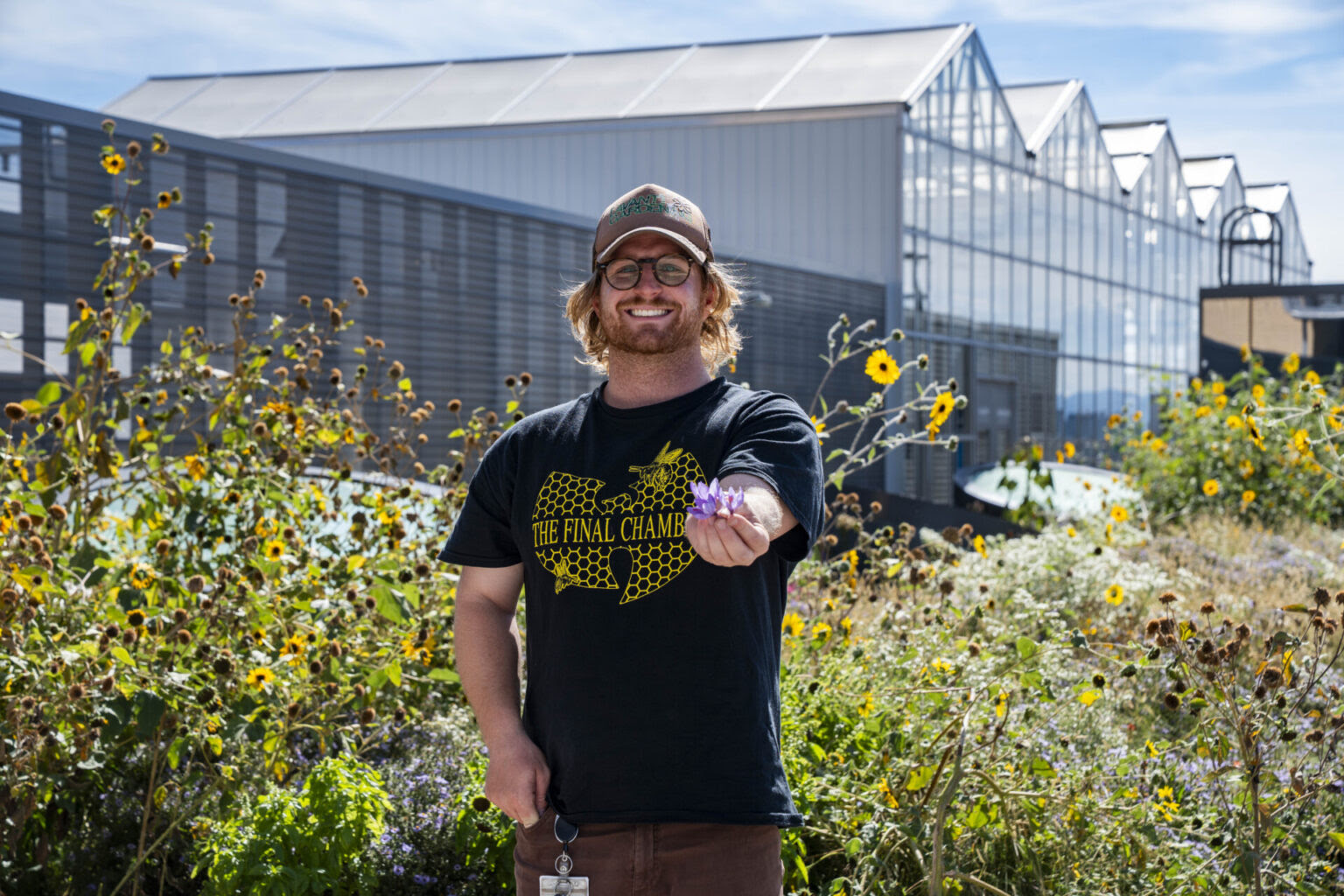
Researchers are testing whether the high-value, drought-resistant spice could help Colorado agricultural producers diversify their crops, conserve water, and generate late-season revenue.
by North Forty News Staff | NorthFortyNews.com
A tiny purple flower that produces the world’s most expensive spice could eventually offer Colorado farmers a new way to earn income while using less water.
Researchers at Colorado State University are studying whether saffron, a crop traditionally associated with the Middle East, can thrive in Colorado’s dry climate and high-elevation growing conditions.
The research could affect agricultural communities across Northern Colorado, where producers face rising operating costs, water limits, and growing pressure to find profitable alternatives to traditional crops.
At CSU Spur in Denver, horticulture graduate student Reece Bailey has planted dozens of saffron bulbs in rooftop gardens to evaluate their productivity, irrigation requirements, and potential as a supplemental crop.
“One thing that’s always been interesting to me is new ideas and novel ways of integrating crops into our environments,” Bailey said.
A High-Value Crop With Low Water Needs
Saffron commands extraordinary prices because harvesting it is labor-intensive. A pound typically sells for $600 to $5,000, with certain varieties reaching $10,000.
The spice comes from three delicate red stigmas inside each purple flower. Workers must carefully remove the stigmas by hand, and it takes about 75,000 flowers to produce a single pound of dried saffron.
Despite those challenges, researchers believe its potential value and relatively low water requirements make it worth investigating.
Bailey said saffron requires roughly half the water needed to grow corn and may grow with rainfall alone under suitable conditions.

“This crop is incredibly drought resistant,” Bailey said.
For Northern Colorado farmers who depend on irrigation systems, groundwater, and increasingly unpredictable precipitation, those characteristics could make saffron an appealing option.
Unlike many traditional crops, saffron blooms late in the growing season, typically around November. That timing could allow producers to generate additional revenue after harvesting their primary crops.
The Colorado Department of Agriculture awarded the research project $80,000 through its Specialty Crop Block Grant Program.
“For a lot of farmers, the price for their goods isn’t keeping up with the price of inputs, so what we’re really trying to do is find new crops that will work with Colorado’s climate and for our producers’ bottom line,” said Sam Hahn, the department’s next generation and specialty crops program manager.
“Saffron has a high labor input, but it could really be a boon for our farmers.”
Growing Saffron Beneath Solar Panels
One of the research project’s most promising discoveries involves growing saffron alongside solar energy installations.
At CSU Spur, Bailey is testing saffron in rooftop gardens, including an agrivoltaic system where plants grow beneath solar panels.
His research has found that saffron yields nearly double under the partial shade provided by solar arrays.
That finding could be particularly relevant as Colorado agricultural producers explore ways to combine renewable energy production with traditional farming operations.
“This could provide cash flow value for farmers who want to use solar as an energy source, or who happen to be in an urban agriculture setting,” Bailey said.
Jennifer Bousselot, an associate professor of horticulture and landscape architecture at CSU and Bailey’s faculty adviser, said saffron seems especially well suited to the growing conditions found in engineered rooftop gardens.
“I’m always curious about how different plants evolve and how they adapt to green roofs, and lately, I’ve come to realize that saffron is almost the ideal plant for these environments,” Bousselot said.

The research could eventually help agricultural producers determine whether saffron can be grown alongside solar infrastructure without competing for additional farmland.
Could Saffron Work in Northern Colorado?
Although the research is still developing, Colorado’s climate shares characteristics with major saffron-producing regions.
Iran, which produces about 85% of the world’s saffron, has mountainous, semi-arid growing conditions similar to parts of Colorado.
Researchers are testing saffron at CSU Spur, CSU’s Foothills Campus, and Chatfield Farms at the Denver Botanic Gardens.
They have also distributed bulbs to farmers in Paonia, Pueblo, and Montrose to gather information about growing conditions and agricultural applications across the state.
Northern Colorado’s agricultural communities, including those in Larimer and Weld counties, could eventually benefit from the findings.
However, researchers have not yet established whether saffron can be grown profitably at commercial scale throughout the region.
Farmers would still need answers about startup investments, bulb availability, harvesting labor, equipment, marketing, and potential buyers before adopting the crop.
Labor requirements are particularly significant because saffron flowers bloom only briefly each morning, requiring careful harvesting during a narrow window.
Still, Hahn said identifying alternative crops is becoming increasingly important as Colorado agriculture adjusts to changing environmental and economic conditions.
“It’s so important that we experiment with these high-value crops to see if it can supplement the market in our state and keep us competitive,” Hahn said.

Demand Extends Beyond the Kitchen
Saffron has been prized for thousands of years for its flavor, color, fragrance, and traditional medicinal uses.
Today, it remains an important ingredient in dishes such as paella and risotto and is increasingly used in perfumes.
Researchers have also investigated saffron’s potential health applications, including possible effects on depression and inflammation, although those findings do not establish it as a substitute for approved medical treatments.
Its broad range of applications could create additional markets for Colorado-grown saffron if production proves economically viable.
For Bailey, the research represents an opportunity to reconsider what crops can succeed in the American West.
“Up until now, we haven’t really been able to study saffron in Colorado at a deeper level, but the demand is there, and I only think we’ll be talking about it more and more,” he said.
For Northern Colorado’s agricultural producers, the bigger question is whether this small, valuable flower could become another tool for keeping farms profitable in a changing climate.
Source: Colorado State University, CSU Spur, and the Colorado Department of Agriculture.